
FishNet USA Home Printable PDF Version FishNet USA Directory
|
|
|
FishNet USA Home Printable PDF Version FishNet USA Directory |
Fishing-Centric Management
FishNet USA – June 16, 2008
Fishing-centric management
Suppose you were in charge of managing a fishery, and you knew that the bays and estuaries in a well defined area served as the prime nursery for the species you were managing. Additionally, suppose that you knew that the ability of those particular bays and estuaries to serve as nursery areas had been severely compromised.
As a rational manager, how would you proceed? Would you assume that you could, without doing anything to improve those bays and estuaries as nurseries, still return the fishery to early-1900s levels of abundance by controlling other factors? That seems highly unlikely, and yet….
NOAA Fisheries has outlined new measures to prevent overfishing and rebuild the number of sandbar sharks and other species. The number of sandbar sharks are [sic] between 20 and 38 percent of the population in the early 20th century before fishing began on sharks…. The FEIS (Final Environmental Impact Statement) will cut the sandbar shark quota from 1,017 metric tons to 87.9 metric tons, an 85 percent reduction, per year from 2008 to 2012 (NOAA Fisheries Service – FishNews April 28, 2008)
If you consider how we have been managing our fisheries in recent years, this is a seemingly reasonable management program. It’s focused completely on restricting harvesting, and it implies that if you do that rigorously enough you’ll be able to return the diminished shark population to pre-harvest levels. It’s a reflection of the mind-set that has controlled fisheries management, and fishing, for approaching a half a century. For lack of a better term, we’ll call it fishing-centric management.
How effective is this form of management? Based on the current condition of intensively managed fishery after fishery, or more accurately on the current condition of fishery after fishery where fishing effort is intensively managed, not very. New England groundfish, Gulf of Mexico snapper/grouper, Pacific rockfish and a host of other fisheries in which fishing effort has been managed almost into oblivion attest to how “effective” this management philosophy can actually be.
The anti-fishing community would have us believe that this is because the effectiveness of the management system has been destroyed by short-sighted and self-serving fishing interests and the pandering of their elected representatives. Actually, an examination of NMFS records for the years from 1991 to 2006 show that commercial fishing industry members or representatives made up, on the average, only 30% of the total voting membership of all of the regional fisheries management councils. This is hardly a percentage that would allow the fishing industry to distort the entire management process, but as we’ve seen in many other instances, the members of the anti-fishing claque are far less interested in actual facts than they are in creating perceptions that are more supportive of the fictions they’re pushing.
But even assuming that commercial fishing isn’t distorting the management process, then why, in fishery after fishery, isn’t management working the way it is supposed to? Why, in spite of cutback after cutback in fishing effort, aren’t rebuilding targets being met? Why, in spite of increasingly restrictive management measures extending back for years, aren’t we up to our figurative ears in fish?
A closer examination of the announced sandbar sharks management program makes the answer abundantly clear. In fact, fisheries management is to a large extent ineffective because the wrong things are being managed.
Sandbar sharks as an example
The bays and estuaries from Delaware to North Carolina, and particularly the Chesapeake Bay (http://www.vims.edu/library/Theses/Ellis03.pdf), are recognized as the prime nursery areas for the western North Atlantic population of sandbar sharks (Florida Museum of Natural History website at http://www.flmnh.ufl.edu/fish/gallery/Descript/Sandbarshark/sandbarshark.htm). This being the case, it would seem imminently logical in any non-fishing context that any serious attempt to manage sandbar sharks would consider the condition of those estuaries, both today and in the baseline years, which, as specified in the FEIS, are “the early 20th century before fishing began on sharks.” It is also, we must add, the time before our estuaries started a serious period of decline.
When we do that we find that:
Accompanying the burgeoning of the human population in the watersheds was a burgeoning of the effluents pumped or washed or flushed into the estuaries. Hence the SAV loss, which hasn’t been limited to the Chesapeake and can be extended to the other sandbar shark nursery areas, the plight of the Chesapeake blue crab (see http://www.forbes.com/feeds/ap/2008/04/14/ap4887527.html) and oyster fisheries, the mycobacterial infections in striped bass and other fish species in the Chesapeake (Mycobacteria as Environmental Portent in Chesapeake Bay Fish Species at http://www.cdc.gov/eid/content/13/2/329.htm), and other signs of a serious decline in the health of the Chesapeake and the other nursery estuaries.
With half of the original wetlands and 90% of the SAV that condition the water and provide much needed habitat in the nursery estuaries gone, with the wastes of 3 times as many people making their way into those estuaries and with each of those people releasing far more noxious wastes than people released at the turn of the last century, they have long since lost the ability to produce anything near the number of sandbar sharks – or any other estuarine dependent species - that they had “in the early 20th century.” In tech-speak, their carrying capacity has been diminished.
Unfortunately, the impact that these declines in the condition of the estuaries have had on the sandbar shark stock is magnified. In a College of William and Mary masters thesis in 2003, J.K. Ellis determined that blue crabs, one of the casualties of that decline, make up the largest part of the diet of smaller sandbar sharks sampled in the Chesapeake (http://www.vims.edu/library/Theses/Ellis03.pdf). Not only are the sharks suffering a loss of nursery habitat, they’re also suffering a loss of one of their primary sources of food.
“Shifting baselines” and fisheries management
The sandbar shark FEIS is also a reflection of one of the current infatuations of the so-called marine conservation - more accurately described as the anti-fishing - community: the shifting baseline phenomena. This is when we have lowered expectations for rebuilding a fish stock because we evaluate the conditions of our fisheries resources only relative to what they were within current memory, not going back to pre-fishing conditions.
These “conservationists” and their subsidized scientists have made much of shifting baselines. They would have us believe that our fisheries management goals should not be based upon well-documented, relatively recent levels of abundance, but rather upon mythical levels of abundance extrapolated by their scientists from historical documents. (Of course, if those documents were of recent vintage, they would be dismissed out of hand by those same scientists as anecdotal and not worthy of serious consideration, but that’s a totally different issue.)
While we give the results of this skewed “research” the scant credit it is due, we heartily endorse the concept of recognizing that particular baselines, baselines that are critical to the productivity of our fisheries and to the future of ocean management, be given more attention. In fact, in our last FishNet, Getting Real About Ecosystem Based Management (http://www.fishnet-usa.com/ecosystem_management.htm), we discussed drastic changes in one of the extremely important baselines that has shifted significantly in the last half a century. Prior to the 1970s, marine mammals weren’t considered an important part of the ecosystem worthy of protection, but were looked at as another ocean crop to be harvested. This kept their populations down far below “natural” levels, as it did their levels of predation on other marine species that were either being harvested or that were food for those harvested species. Since then, most stocks of marine mammals have benefited hugely from being protected, and as we pointed out, this has been at a tremendous cost to their prey species and to the fishermen who target those species.
As we concluded, “in the Northwest Atlantic in 2006, marine mammals ate approximately 13 times as much fish and shellfish as commercial fishermen landed, and the annual increase in their total consumption might well have exceeded the East Coast landings in 2007.” This isn’t a condition limited to the Northwest Atlantic.
So, we must ask, which are the appropriate baselines that we should be considering? Should our fisheries rebuilding targets be based on those “good old days” when whales and dolphins and seals were the targets of focused and efficient harvesting and were therefore not competing with the fishermen, or should they be based on the realization that hundreds of millions of tons of fish and shellfish and the prey species that sustain them are no longer available to the fishermen – or as food to the species the fishermen target - because they’ve now become whale and dolphin and sea lion fodder? It’s impossible to rationally argue that it should be the former, yet that’s what the anti-fishing claque has been doing.
Sadly, it’s doubtful that the resurgence of marine mammals is the greatest non-fishing factor that is impacting on our fish stocks or is the only reason that our rebuilding baselines, what they are based on and what they should be, need to be reconsidered.
It’s all about carrying capacity – or it should be
The carrying capacity is the number of individuals or the biomass of a particular species that an ecosystem can support, given a particular set of conditions. Our fisheries management targets are based on some hypothetical carrying capacity – or rather, on the maximum sustainable yield (MSY), which is a calculated percentage of the carrying capacity.
However, when the MSY is calculated, what factors are taken into consideration? With all of the bureaucratic posturing that has accompanied the supposed shifting of emphasis in the National Marine Fisheries Service to that agency’s version of ecosystem based management, you would expect that at least the major factors that impact on fish stocks would all be considered in managing those stocks.
From our examination of marine mammal predation, that is far from the case. In fact, though it can be argued convincingly that marine mammals have much more impact on fish stocks in the Northwest Atlantic than fishing does – because marine mammals eat at least ten times as much as fishermen catch – this is effectively ignored by fisheries managers. As with sandbar shark management, fishing is automatically assumed to be the major source of mortality, and the corresponding assumption is that when fishing is reduced sufficiently, the stock being fished will “recover” sufficiently to allow harvesting at the MSY level. Until that point, of course, harvesting will have to be restricted to allow “rebuilding.” But with marine mammal stocks increasing, with coastal populations growing and coastal development continuing, with the carrying capacity in what appears to be a constant state of downward flux, when is the MSY level ever going to be reached?
It’s not all about fishing – but the managers act as if it is
In written testimony presented to the House Fisheries, Oceans and Wildlife Subcommittee on 12/05/07, NMFS Chief Scientist Steve Murawski wrote:
“Rebuilding targets and productivity levels that will achieve these targets are based on the results of NMFS’ stock assessments. These assessments estimate the history of a stock’s abundance, productivity (growth and recruitment), and fishing mortality as a basis for determining its status relative to overfishing criteria, its sustainable harvest level, and other factors. These assessments generally use a wide suite of fishery and survey data including total catch, catch age composition, survey abundance index, etc. In some cases, the level of abundance that corresponds to the rebuilding target has occurred within the recent history of the stock and is directly represented in the data. In other cases, especially where the time series of high quality data is much shorter than the history of substantial levels of fishing, the level of abundance that corresponds to the rebuilding target occurred prior to the data-rich period. In these cases, good estimates of the rebuilding target can still be made by using the average level of productivity (recruitment) that occurred during the data-rich period and the biomass per recruit that would occur when fishing at target levels and using the stock’s biological characteristics and fishery characteristics from the data-rich period.”
As Dr. Murawski makes clear in his testimony, in fisheries management the available fisheries data is what in fact actually “drives” the management process. What of other, and possibly equally or more relevant, data pertaining to environmental changes? The focus on “the biomass per recruit that would occur when fishing at target levels and using the stock’s biological characteristics and fishery characteristics” doesn’t specifically allow for continuing or accelerating environmental degradation, rebounding marine mammal stocks, climate- or weather-induced regime shifts or any other factors extrinsic to the stock being managed. Rather, all of these factors get lumped together into what is called natural mortality, which is a catch-all category including all of those fish that succumb to non-fishing causes such as pollution, being eaten, dying of old age, etc. Natural mortality is estimated and is considered to be constant for each stock being managed.
What are the practical implications of this fishing-centric approach to management? One might argue that how a stock of fish reached a particular point is irrelevant to how fishing on that stock should be managed, but that is far from the case. If a stock is at the point of MSY, it can sustain a particular level of fishing indefinitely (until conditions change). If it is below MSY, according to the mandate of the Sustainable Fisheries Act it must be “rebuilt” to the MSY level. A given biomass could support a higher TAC (Total Allowable Catch) at the MSY level than if it was below MSY and in the forced rebuilding mode.
For the fishermen in a particular fishery, this could be a path to inevitable extinction. In the case of sandbar sharks, for example, nothing is ever going to return the nursery estuaries to the condition in which they can once again support the numbers of juvenile sharks that they did in the early 1900s, at least nothing that’s likely to happen in the foreseeable future. Yet this appears to be the level of juvenile sandbar shark production that is necessary to restore the stock to the target MSY level. So every year it is determined that there aren’t enough sandbar sharks – that the stock is behind on its “rebuilding” trajectory – fishing will be reduced.
Or take summer flounder, inarguably one of the most valuable fisheries in the mid-Atlantic. The summer flounder population is at the highest level ever measured, but the biomass isn’t increasing rapidly enough to meet the rebuilding target. Now, where the summer flounder stock should be on its rebuilding trajectory at any particular point in time is calculated, and the calculations involved are based on the current condition of the summer flounder stock and the assumption that if it doesn’t increase at a particular level, the fishing mortality is too high and must be reduced. The desired level of increase is based on retrospective analyses of how the summer flounder stock has performed in the past and the assumption that it will perform that way today and into the future. Obviously this assumption is based on yet another assumption: that all of those conditions that influence the summer flounder stock – other than fishing – remain constant.
Again, these are all seemingly reasonable assumptions, unless you throw a couple of other factors into the mix.
Dogfish again
While NMFS trawl survey data isn’t as convincing as the “anecdotal” observations of both recreational and commercial fishermen from the Gulf of Maine to Cape Hatteras, it’s hard to ignore the fact that there is a “plague” of spiny dogfish in the waters between Cape Hatteras and the Gulf of Maine (see Dogfish Follies at http://www.fishnet-usa.com/dogfishfollies.html and note that the survey trends have continued in the years since this was written). These voracious and low-value fish are interfering with just about every commercial and recreational fishery in areas where they are prevalent; stealing bait, clogging nets, destroying gear and damaging other, more valuable species before they can be brought on board.
Quoting from the Cornell University’s Suffolk County (NY) Cooperative Extension Service’s summer flounder Species Profile, (http://counties.cce.cornell.edu/suffolk/Fisheries/species/summer%20flounder.pdf) “summer flounder have been found in the stomachs of spiny dogfish, blue shark, little skate, Atlantic cod, silver hake, goosefish, northern sea robin, spot, bluefish, and winter flounder (Bowman and Michaels 1984; Kohler 1988; Rountree 1999; Bowman et al. 2000), of which spiny dogfish are the most significant predator” (emphasis added). But, in spite of the fact that that the summer flounder fisheries have been, are and always will be far more valuable that the dogfish fishery, the requirements of the Magnuson Stevens Act are such that spiny dogfish harvesting must be restricted, not just until but even after the stock has “recovered.”
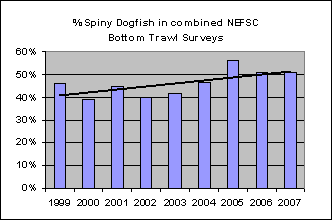
Here’s a species that, considering the negative impacts on other fisheries, it’s hard to imagine should be managed with anything other than a bounty or some other harvest incentive. Instead, spiny dogfish are and will continue to be protected. This is bad enough, but it becomes immeasurably worse when one considers that, impossible though the task is, recreational and commercial fishermen are expected to make up for dogfish depredations on other species like summer flounder by reducing their harvest. As the dogfish population increases their predation on summer flounder increases so the recreational and commercial harvest of flounder must be decreased accordingly.
And these are far from unique situations
It’s only in the last century that we’ve really been capable of producing environmental insults with the magnitude to impact not just our estuaries and near-shore waters, but entire oceans, and we’ve done that with a vengeance. Plastics, personal health care products, household chemicals or their decomposition products have all become ubiquitous in the marine environment, as have their impacts on marine organisms. While our impacts on the terrestrial environment are easily observed – and can be evaluated on the scale of an individual’s life, that generally isn’t the case with the oceans. Hunks of floating Styrofoam, plastic bags and butane cigarette lighters are easy to see, and the effects of too excessive nutrient run-off – red tides and dead zones – tend to be in areas where they attract much public attention. But the subtle effects of the excess pharmaceuticals and their residuals, of fire retardants, of herbicides and pesticides, of sun tan lotions, detergents and the full spectrum of excess “stuff” that makes it’s way from our bodies, our homes, our yards and our workplaces into the estuaries (with their drastically reduced assimilative capacities) then the oceans are all but ignored by society.
No one expects that the terrestrial environment in 2008 is going to bear any resemblance to what it was in 1908. With almost 7 billion people, well over a billion motor vehicles, a quarter of our land area devoted to growing livestock feed or for grazing, and our per capita consumption of just about everything at levels that were unthinkable a hundred years ago, how could they? What we’ve been doing on the land is at best reflected and at worst concentrated in our inshore and offshore waters.
Yet the “conservationist” agenda and our fisheries management system assume that the carrying capacity of our marine waters hasn’t changed in a century, and that when that capacity isn’t reached, it’s time to cut back on fishing once again. How much of this economically devastating cutting back can the commercial fishing industry endure?
************************************************
The Oil Slick
It’s becoming increasingly popular in the “marine conservation” community to directly engage the seafood consumer in pushing the anti-fishing agenda. The poorly crafted science that their campaigns rely on not being readily accepted by the fisheries managers – or by anyone else with any practical knowledge of fisheries or oceanography and regard for viable commercial fisheries, for that matter – they are now attempting to directly influence consumers, whose lack of knowledge of what’s going on in the oceans is exceeded only by their insatiable craving for fish and shellfish.
They rely on some form of “grading” of various seafood products, supposedly based upon the sustainability of the fisheries that produce them. Were that the actual case, most people involved in commercially harvesting seafood would find little to object to. A simple declaration of whether a product was from a fishery that was overfished or not and, if it was, whether it was rebuilding or not, would certainly help the conscientious consumer, and would have little effect on the vast majority of our fisheries, which are well along in management-mandated rebuilding programs.
Unfortunately, that is far from the case. Rather than restricting themselves to such seemingly simple concepts as overfished and overfishing, their ratings systems are also based on other, far more problematic, criteria such as gear type, the degree of illegal, unreported or unregulated fishing (IUUF), and other consumer-confusing esoterica. In many cases their ratings are out-of-date and internally inconsistent as well.
For a few examples:
So, according to these self-styled arbiters of consumers’ environmental consciences, species “X” is to be avoided because it’s caught with a gillnet but species “Y” is ok even though caught with the same gear? Species “W” is to be avoided because it’s classified as “overfished” though that classification was officially dropped several years ago? That the same fishery that catches species “C” in an acceptable manner is dropping the ball on species “D,” even though they are both caught on the same gear in the same manner on the same trips?
It seems as if the zeal being put into “protecting” the fish by these groups isn’t accompanied by a corresponding zeal to get the grading systems right or to assume any responsibility for the damage done to fishermen, wholesalers, retailers, restaurateurs, consumers or anyone else who is impacted by the inability to keep up with progress in fisheries management.
What is a conscientious consumer supposed to do? Even more importantly, what is a conscientious fisherman supposed to do? He or she plays by the rules, abides by a thousand and one regulations ranging from the picayune through the obvious to the ridiculous and is then financially punished because the people in the agency that promulgates those rules don’t see eye to eye with the foundation-funded antis.
We can only suggest that anyone with an interest in the real-world performance of a fishery avail themselves of the information available on the National Marine Fisheries Service FishWatch site (http://www.nmfs.noaa.gov/fishwatch/). The information there is that which the Greenpeace people and the Monterey Bay Aquarium people and a bunch of others spin to suit their personal and institutional agendas. It isn’t six months (or six years) out of date, and it’s about the best indication that the fish you are buying have been caught by fishermen legally participating in what have become the most intensely scrutinized and thoroughly managed fisheries in the world.