|
|
|
|
|
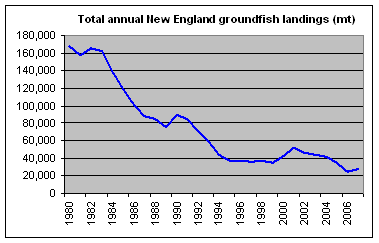
Same-old same-oldd getting old for groundfish (from the November, 2008 issue of National Fisherman) The graph below shows what’s been going on with New England groundfish landings since 1980. Pretty impressive, isn’t it? What would be even more impressive would be a representation of the failed businesses, human suffering and destroyed careers brought about by that 83% decline. Or all the public dollars it’s taken to manage it.
It’s hard to suggest that New England groundfish management has been anything but a dismal failure, and where does the responsibility for that lie? How about on the desk of the Secretary of Commerce? We’ve all heard the “blame it on industry influence, political pressure, conflicts of interest” arguments, in fact blaming it on everything but the Bossa Nova. But the Department of Commerce, adhering to the game plan provided by Congress, interprets the legislation, supplies and/or coordinates the research, provides the administrative support, and approves, imposes and enforces the management measures that have gotten us to where we are. That’s why it’s impossible for me to understand the Secretary’s insistence – as expressed at a special meeting of the New England Council addressing the latest bad news about the collective groundfish stocks – on staying the course for a couple more years. The landings have been going down almost 3% a year for almost 30 years. Does anyone have any reason to suppose that two more years won’t mean another 6% decline? How many boats and how many groundfish fishermen, not to mention the people and businesses depending on them, will be left? Groundfish landings are at 17% of their 1980 levels. What about the groundfish stocks? Are they down? Some stocks are higher than they were back then, some are lower, and some are at about the same level. Charts on pages 2-861 and 2-862 of the “Ecosystem Considerations” section of the GARM III report (available via the Northeast Fisheries Science Center website) show that in the spring and autumn trawl surveys, the stratified average weights per tow of “all GARM stocks” have in recent years been very close to what they were in the 1980s. So, with as many fish out there today as there were in 1980, or for the sake of argument, even with 50% as many, where’s the justification for landings reduced by 80%? Or by another 6% over the next two years? Folks, what we have is a seriously broken system that we should have committed to fixing years ago. And fixing it is going to require much more than figuring out yet another way to divvy up an ever-diminishing catch, because the catch has already been diminished far more than it should have been. For a start, what about questioning some of the basic premises of Magnuson management. Can we ever have every fishery out there at the Optimum Yield level simultaneously? From the “Ecosystems Considerations” referenced above, the answer to that is theoretically yes, but perhaps not. The big question, however, is that, considering the implications of managing for the weakest species, why should we? How many dollars worth of flounder, cod and pollock do the dogfish that are now infesting our waters from Cape Hatteras to The Hague Line cost us – and we still don’t have enough of them? How can we severely restrict fishing on historically large populations of haddock and redfish to protect small numbers of less robust species? How can we force fishermen to continue to struggle for an increasingly meager catch in a handful of fisheries when there are other fisheries “right next door” they can be successful in? How can we manage a dozen different species sharing the same water, eating the same food (or each other) and vulnerable to the same gear as if each is in its own isolated universe? And most importantly, how much longer are we going to pretend that fishing mortality is the only thing that matters? New England groundfish – or the way that we have been attempting to manage them for a generation - have put us in a box that we have to start thinking outside of, and just coming up with another way to allocate the same amount of fish doesn’t seem to me like it’ll do the job. At this point powerful people in Congress are focused on groundfish, and they should know as well as anyone that it’s time for some significant changes. Assume we’re on the Titanic. Painting the grand salon, designing a new menu and rearranging the furniture isn’t going to keep us out of the ice. Setting a new course will. Nils E. Stolpe |